This long course covers foundational agile practices and how to apply them inside Jira to plan, estimate, and deliver work predictably. You will be introduced to core Agile values and Scrum roles before moving into story and sprint-level practices: using INVEST to assess story readiness, applying a Definition of Done to verify task completion, and conducting sprint planning with story-point estimation and work breakdown techniques. The course emphasizes practical use of Jira boards, backlog management, retrospective actions, and timeline planning so learners can coordinate with cross-functional teams and support predictable delivery. You will practice translating product backlogs into prioritized, estimable items, applying planning artifacts to Jira, and using retrospective frameworks to create action items and follow-through. The content aims to give early-career practitioners the confidence to participate in ceremonies, contribute estimates, and convert team agreements into Jira artifacts that maintain transparency and continuous improvement in delivery cadence.

Agile Sprint Planning and Delivery with Jira

Agile Sprint Planning and Delivery with Jira
This course is part of Jira Essentials: Beginner-Intermediate Mastery Professional Certificate

Instructor: Professionals from the Industry
Included with
Recommended experience
What you'll learn
Apply INVEST and Definition of Done to verify story readiness.
Run story-point estimation and translate work into sub-tasks.
Conduct sprint planning and record sprint artifacts in Jira.
Use retrospectives to create and track action items.
Details to know

Add to your LinkedIn profile
March 2026
See how employees at top companies are mastering in-demand skills

Build your Support and Operations expertise
- Learn new concepts from industry experts
- Gain a foundational understanding of a subject or tool
- Develop job-relevant skills with hands-on projects
- Earn a shareable career certificate from Coursera

There are 5 modules in this course
This module transforms your understanding of Agile from a mere buzzword into a practical mindset. You will explore the "why" behind Agile's core values and the "how" of Scrum's framework, which is built on transparency, inspection, and adaptation. A key focus is mastering the distinct roles of the Product Owner, Scrum Master, and Developers to prevent common dysfunctions. Through realistic video scenarios, you will learn to diagnose and solve real-world team problems, equipping you to move from theory to application, enhance accountability, and deliver superior value in a sustainable work environment.
What's included
4 videos2 readings3 assignments
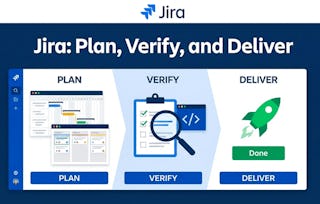
"Jira: Plan, Verify, and Deliver" is a hands-on module that helps you add structure and predictability to your agile team's workflow. It moves beyond basic ticket-tracking, teaching you two powerful quality gates: the INVEST criteria for user stories and the "Definition of Done" (DoD). You will learn to inspect user stories for clarity and readiness before development starts. Then, you'll master using a DoD checklist to verify that completed work meets all agreed-upon standards. Through practical simulations in a Jira-like environment, you will learn to reduce ambiguity and ensure every task is truly "Done."
What's included
2 videos4 readings4 assignments
Go from sprint participant to planner with "Plan, Estimate, and Break Down Sprints." This module is for any agile team member who wants to deliver successful sprints. You will master facilitating the Sprint Planning ceremony to drive team commitment. You'll learn collaborative agile estimation using story points to assess complexity. You will also practice breaking down user stories into granular subtasks in Jira to improve visibility. By the end, you can build a clear, realistic sprint backlog, ensuring that your team starts every sprint with a plan built for success.
What's included
6 videos4 readings5 assignments
"Jira for Effective Retrospective Actions" helps agile teams turn feedback into measurable change. This beginner's module teaches you to use the Start-Stop-Continue framework to generate actionable tasks from team insights. Through hands-on tutorials, you will use Confluence and Jira to document outcomes, assign ownership, and track action items. This module moves your team beyond discussion to drive accountability and tangible progress. You will finish with the ability to build a transparent system that closes the feedback loop, ensuring your team consistently learns and evolves from its experiences.
What's included
2 videos5 readings3 assignments
"Optimize Project Timelines with Jira Mastery" is a module for any team member who wants to build dynamic project plans. You will learn to structure projects by breaking them down into Jira epics and stories. The module teaches you to create timelines, set schedules, and link dependent tasks. Crucially, you will learn to analyze your team's workload to spot and flag over-allocation, preventing burnout. By the end, you can create transparent, predictable, and sustainable project plans in Jira, ensuring your team is set up for success from the beginning.
What's included
3 videos5 readings5 assignments
Earn a career certificate
Add this credential to your LinkedIn profile, resume, or CV. Share it on social media and in your performance review.
Instructor

Offered by
Explore more from Support and Operations
Why people choose Coursera for their career

Felipe M.

Jennifer J.

Larry W.

Chaitanya A.

Open new doors with Coursera Plus
Unlimited access to 10,000+ world-class courses, hands-on projects, and job-ready certificate programs - all included in your subscription
Advance your career with an online degree
Earn a degree from world-class universities - 100% online
Join over 3,400 global companies that choose Coursera for Business
Upskill your employees to excel in the digital economy
Frequently asked questions
No. The course introduces Agile and Scrum concepts with hands-on examples and templates.
Boards, backlog views, basic timeline fields (start/due dates), and issue breakdowns—no admin access required.
This long course is estimated at ~10–12 hours, including short-course modules and labs.
More questions
Financial aid available,
¹ Some assignments in this course are AI-graded. For these assignments, your data will be used in accordance with Coursera's Privacy Notice.